
The Role of RFID in Smart Manufacturing 2026: How Connected Production Lines Enable Industry 4.0
The Role of RFID in Smart Manufacturing 2026: How Connected Production Lines Enable Industry 4.0
Published: July 15, 2026 · Category: Industry News
Industry 4.0 promises a factory that senses, decides and self-optimizes. At the physical layer, that vision depends on a simple, unglamorous technology: RFID. Every workpiece, tool, bin and returnable container that carries a tag becomes a node the system can locate, count and learn from in real time. In 2026, the manufacturers pulling ahead are not those with the most robots, but those with the cleanest, most complete item-level data -- and RFID is how they get it. The equipment that produces those tags and inlays is therefore the silent foundation of the connected factory.
From Blind Floors to Live Digital Twins
A conventional line knows what it made in aggregate at shift end. An RFID-enabled line knows where every unit is at every second. As carriers and parts pass fixed or handheld readers, the system reconstructs a live digital twin of work-in-process: which station is the bottleneck, which batch is at risk, which tool is due for service. This visibility turns firefighting into forecasting and lets planners rebalance load before a delay cascades. The prerequisite is a trustworthy supply of inlays and tags -- exactly what automated embedding, testing and sorting lines are built to deliver at scale.
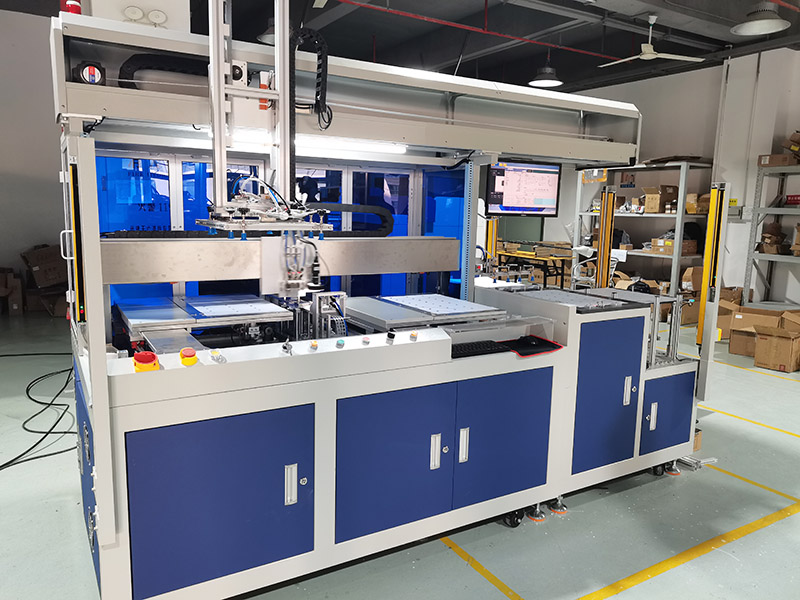
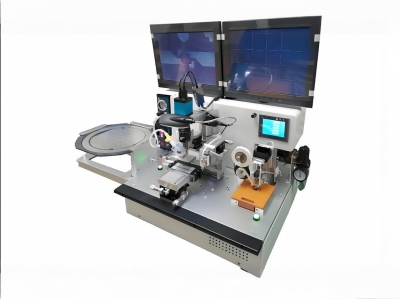
Zowinda RFID production and testing equipment -- the reliable foundation for Industry 4.0 smart manufacturing and connected factories.
Core Capabilities
Six engineered capabilities define this solution:
Real-Time WIP Visibility
Item-level tags update the MES the instant a unit moves, replacing end-of-shift counts with a live production map.
Automated Asset Tracking
Returnable totes, fixtures and tools are located automatically, slashing search time and shrinkage on the floor.
End-to-End Traceability
Every batch carries a permanent identity through assembly, test and pack for recall-ready quality records.
Equipment-to-Equipment Communication
Machine and material status flow over the industrial IoT, letting cells self-coordinate without manual handoff.
Data-Driven Optimization
Yield, downtime and flow data feed SPC and predictive-maintenance models that raise OEE continuously.
Misread-Resistant Tag Production
Inline electrical testing and vision sorting ensure only compliant inlays ship to the line -- bad tags corrupt the data chain.
Technical Specifications
Building the Connected Factory From the Tag Up
The smartest control software in the world cannot compensate for missing or misread tags on the floor. That is why serious adopters treat tag and inlay production as critical infrastructure, not a commodity buy. By pairing robust embedding and testing equipment with inline sorting and MES integration, producers build a data foundation reliable enough to support autonomous replenishment, lot-level genealogy and closed-loop quality. In 2026 the competitive edge in manufacturing is increasingly won at the scale of the individual tag -- and the lines that make them reliably.
Ready to Boost Your Production Efficiency?
Contact us for a tailored solution and quotation.
Email: [email protected]
WhatsApp: +86 186 2085 0485
 How to Set Up a Smart Card Pro
 Antenna Embedding & Wire E
 Smart Card Manufacturing Proce
 RFID Inlay Sample Bonding Mach
Please contact us with your request
We are ready to answer your questions.